
Chemistry and safety: designing the process to ensure product quality
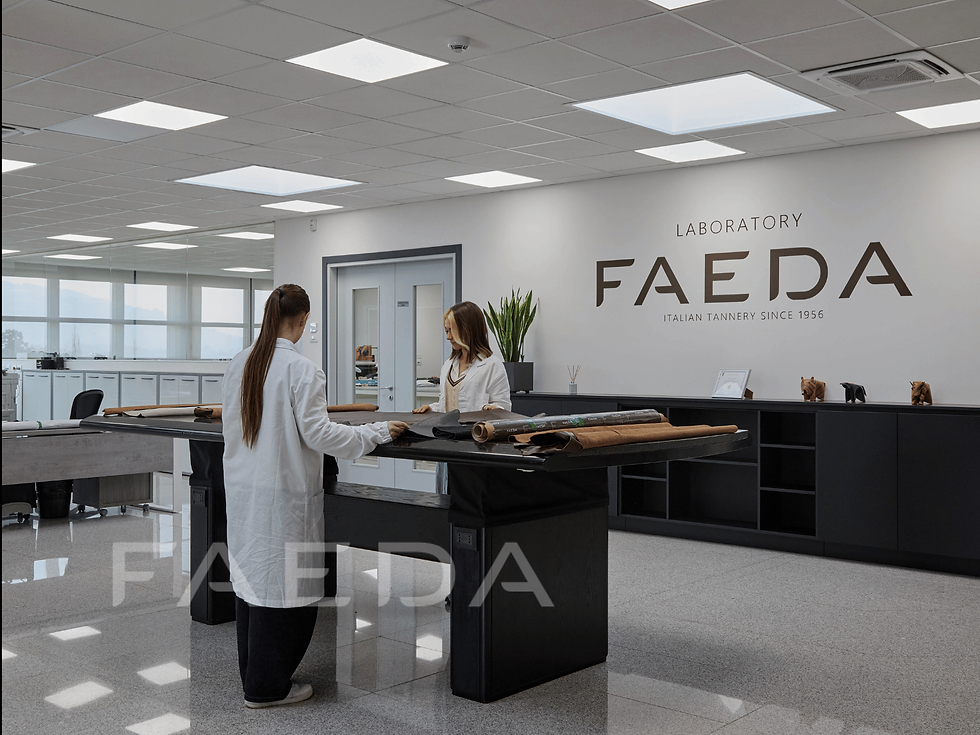
In the tanning industry, chemical management is one of the most critical aspects of the production process. In addition to its environmental impact, the use of chemicals affects the safety of the final product and the people involved in the manufacturing process.
At Faeda, chemicals are not treated as a variable to be controlled at a later stage, but as a strategic lever designed at the outset. Every substance, every formulation, every recipe is part of a structured system that ensures compliance, quality and safety.
Rigorous selection of chemical products
The first level of control concerns product selection. Faeda works exclusively with qualified suppliers, who must guarantee:
compliance with international regulations
complete technical documentation
up-to-date safety data sheets
Every chemical enters the company accompanied by documentary evidence certifying its composition and compliance.
International standards as an operational benchmark
The entire system is aligned with the ZDHC (Zero Discharge of Hazardous Chemicals) protocols, developed by leading luxury brands to regulate the use of substances throughout the supply chain.
This means operating within restrictive lists, updated periodically, which:
limit or eliminate hazardous substances
define increasingly stringent usage thresholds
guide the entire supply chain towards safer chemicals
Process design and impact reduction
Control is not limited to the choice of substances: Faeda works on the design of the production process, studying product formulations and assessing the behaviour of substances in advance.
Faeda’s approach makes it possible to:
reduce the pollution load
optimise the use of chemicals
prevent critical issues before they arise
Prevention as an operational principle
In this context, sustainability is a consequence of the design process. By analysing formulations in advance, Faeda is able to predict how substances will behave and take action before a problem arises.
It is therefore not a matter of correcting, but of preventing.
Technologies that reduce impact
The introduction of innovative machinery further contributes to this objective. Certain technologies enable the leather to be levelled more effectively, reducing the number of steps required in subsequent stages.
This results in:
lower use of chemicals
reduced energy consumption
lower emissions
Sustainability thus translates into operational efficiency.


Safety for the product and for people
One of the main objectives of Faeda’s chemical testing is to ensure the safety of the final product. Leather intended for the luxury sector comes into direct contact with the human body, making it essential that it is free from harmful substances.
The system adopted by Faeda ensures that:
products comply with customer specifications
the substances used conform to international standards
the risk of allergies or contamination is minimised
Worker protection
Safety also concerns those working within the production process. Controlled chemical management reduces exposure to hazardous substances, helping to create a safer working environment.
This aspect is complemented by:
internal control systems
defined operating procedures
continuous monitoring
Continuous checks and verifications
The system is supported by constant verifications. Chemical products are subject to:
documentary checks
analyses by certified laboratories
customer audits
This ensures that what is declared is always consistent with what is actually used.
Safety as an implicit requirement
In the luxury sector, safety is not something to be promoted, but an implicit requirement. It must be guaranteed without compromise, through reliable and verifiable systems.
Quality as a result of precision
Chemical management has a direct impact on product quality. The stability, uniformity and performance of the leather depend on the precision with which the formulations are designed and managed.
A system that protects value and people
At Faeda, chemistry is an integral part of the industrial system – an element designed, controlled and verified at every stage.
It is the invisible heart that guarantees quality, safety and consistency.